Once you go superflex, you never go back. Wait, that’s not the saying? Well, it should be, because I feel like it’s true — at least in my case, and for many others I’ve introduced to superflex redraft leagues over the years.
Hopefully, you and your league have switched over to superflex by now. If not, you should. Below, I’ll go over the format details and break down three mistakes managers make that can ruin their draft in this format.
PlayerProfiler is home to award-winning dynasty rankings and tools. Our Dynasty Deluxe package includes complete Dynasty Rankings, Rookie Rankings, Trade Analyzer, Draft Planner, Mock Drafts, and more. Check it out right here!
It’s 2026, Stop Falling for these Superflex Draft Mistakes
Mistake 1 | Bypassing the Quarterback Position Early
Superflex drafts are not like standard formats. For the people in the back, I repeat: SUPERFLEX DRAFTS ARE NOT LIKE STANDARD FORMATS.
Most disrespected SF asset:
Jared GoffElite metrics in 25’:
Passing for 4,564 yards (2nd in NFL) and 34 touchdowns with a 105.5 passer rating and 68% completion rate. He led a top offense with 16 big-time throws
– Top 3 receiving core
ADP: QB14 pic.twitter.com/x0uyeEXsgS
— FantasyNerdBoi (@NerdBoiTakes) May 9, 2026
Most redraft leagues are typically 10 or 12 teams, with only one starting quarterback slot. That means only 10 or 12 signal-callers are being used each week. A guy like Jared Goff, who has led the league in total passing touchdowns across the past four seasons and consistently produced as a top-10 fantasy quarterback during that span, isn’t even being drafted as a starter with an ADP of QB16.
That’s crazy.
Switching over to superflex fixes that. Now, you have the option to play a second QB in that superflex (SFX) slot, which is what most managers do nearly every week. Instead of only 10 or 12 quarterbacks being played, now you’ll see 20 to 24, depending on your league size. With that simple change, the most important position in sports goes from an afterthought in fantasy drafts to front and center — how it should be.
That means you need to prioritize the position early.
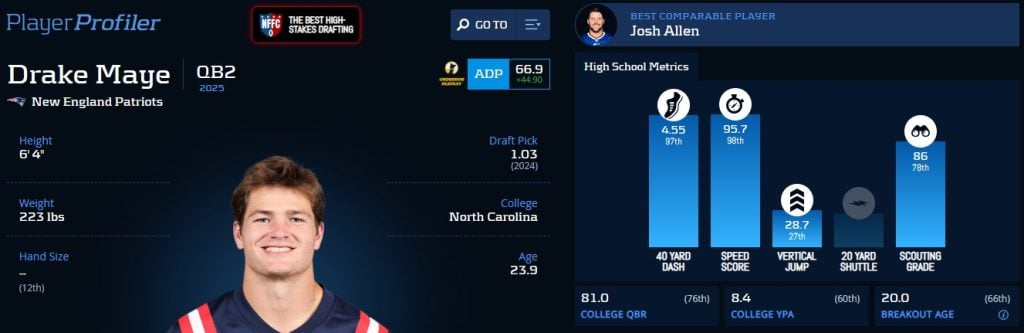
Drake Maye is a first-round pick in Superflex formats
Depending on where you pick, you should look to add at least one QB during your first two selections. You must emerge from Round 2 with at least one “stud” passer, especially if you’re playing in leagues with 12 or more teams. The more managers, the more important it becomes.
Round 1 QB Targets
Round 2 QB Targets
Jalen Hurts is the 1st player in NFL history with a TD pass, a rushing TD & a passer rating of 115+ in 3 straight games 🤯 pic.twitter.com/GJiiVirgiF
— Fantasy Footballers (@TheFFBallers) November 8, 2024
Once you lock in that elite field general, make sure you also get your top options at running back and wide receiver. But you aren’t done yet, because in Rounds 3-5, you probably want to dip back into the QB well once more and secure your second starter.
Round 3 QB Targets
Brock Purdy 24/33, 331 Total YDS, 5 Total TDs, 1 INT vs CHI Tonight.
MR. IRRELEVANT HAS 10 TDs IN THE LAST 2 GAMES. pic.twitter.com/JsXHKBdoU5 https://t.co/jUqlSoo905
— Football Performances (@NFLPerformances) December 29, 2025
Round 4 QB Targets
Round 5 QB Targets
Those are the top 20 quarterbacks, per PlayerProfiler‘s 2026 rankings. Be sure to come away with two of these guys in drafts, if possible. Otherwise, it starts to get really dicey after this group, and you don’t want to depend on lower-tier players in your starting lineup regularly.
Mistake 2 | Waiting Too Long on a QB3 (or Ignoring it Completely)
Alright, so you’ve got two starters you’re confident in. You’re done, right? In the famous words of Lee Corso, “Not so fast, my friend.”
Daniel Jones getting freed from the Giants and immediately turning into Josh Allen is the funniest thing imaginable that could have happened pic.twitter.com/10Krtvsvxq
— NFL Memes (@NFLMemes) September 21, 2025
In 10-team leagues, every manager should be able to nab a third QB. However, in leagues of 12 or more, some managers will inevitably get iced out, leaving their rosters vulnerable during bye weeks or when injuries hit.
Don’t just assume your two starters will go through the season unscathed. Last season, 63 different “point guards of the gridiron” started at least one game, including the playoffs. Injuries will happen. They suck, but you need a backup plan to protect your team.
Investing in a third, or even fourth, QB can be a prudent strategy. They give you someone to use during bye weeks, provide insurance if a starter goes down, and can be valuable trade chips should they produce fantasy points at a decent clip.
QB3 Targets I’d be Comfortable With
After that group, the questions start piling up.
Can Bryce Young take a leap, or will he get benched if he continues his mediocre output? How soon before Carson Beck puts Jacoby Brissett on the bench? Will Kirk Cousins really start over No. 1 overall pick Fernando Mendoza all season if the Raiders aren’t winning games? Which version of Geno Smith will we see in New York (Ed. note: New Jersey?) this year? Who’s the starter for the Brow — actually, that doesn’t matter. Just say “no” to Cleveland quarterbacks.
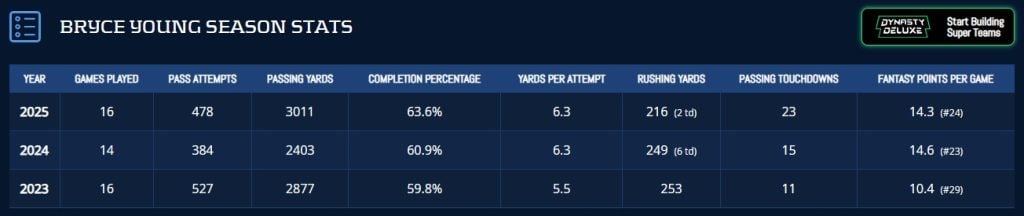
Do you want to trust Bryce Young as your QB2 or QB3?
If you’re one of the last managers in your league to draft a QB2, you should be one of the first to grab a QB3. Get someone with upside (Willis) or job security (Darnold or Jones). In SFX leagues, depth isn’t just a luxury. It’s a safeguard against anything negative.
Mistake 3 | Using Standard Positional Tiers or Rankings
You might be thinking you can use normal rankings and bump QBs up a bit. No harm, right? Well, it’s not that simple. Quarterbacks usually score the most fantasy points (aside from the truly elite running backs or wide receivers), and their value skyrockets when you can start two each week. It’s simple supply and demand.
That naturally drops the relative value of the other positions, though. Running backs, wide receivers, and tight ends will start to fall because the passers are being pushed up. That’s why you need to make sure your rankings or tiers are built specifically for superflex.
🚨Malik Willis might be the ONE…⬇️ pic.twitter.com/BfuqJZVNjY
— Life and Football (@LifeandBall) August 12, 2026
If you’re using normal rankings or tiers, you might completely miss an awesome QB value because they are pushed farther down the list in normal rankings. By the time you realize it, your leaguemates might pick the available QBs clean, leaving you drowning at the position without a lifeboat to rescue you.
Whatever you use — whether you printed list or a draft tool that syncs directly to your league — make sure everything is set to superflex before the draft begins. Otherwise, you’re going to hate life when you’re stuck starting 58-year-old Aaron Rodgers and whomever the Browns roll out every week.
Bonus Mistake: Not Prioritizing Running QBs
Famously dubbed the “Konami Code” by Rich Hribar many moons ago, hyper-mobile QBs are the ones you want to target in all fantasy drafts. It’s simply easier to rack up fantasy points with your legs. In most formats, it only takes 10 rushing yards to get a fantasy point, whereas usually it’s 25 passing yards to earn the same amount.
I recently researched how often quarterbacks who rush for more than 500 yards in a season finish as a QB1 in fantasy. Per Dynatyze data, 56 quarterbacks have topped that mark since 1999. Of that group, 45 (80%) finished as a top-12 quarterback. Even better, 50% of the time, they finished inside the top five.
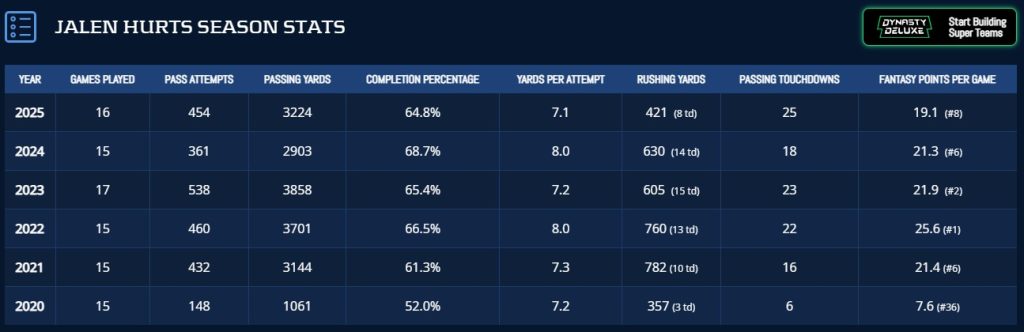
Jalen Hurts’ career stats — rushing yards equals fantasy points
Avoid pure pocket passers and try to nab the dual-threat players. History and data show they are the ones who will typically score the most points. In superflex, where you’re already investing heavily at the position, I want the guys who can still produce even when the passing game isn’t firing.
Wolf Trelles-Heard is a fantasy football analyst for PlayerProfiler.
Follow @DynastyFFWolf