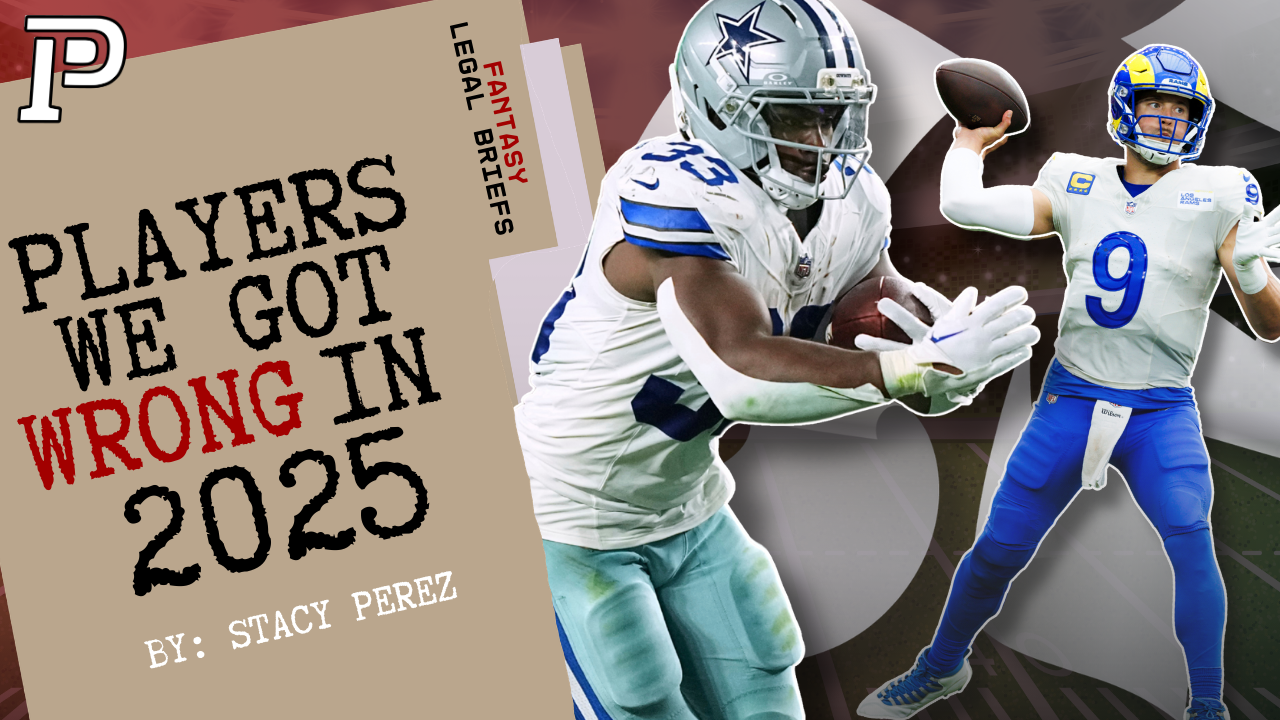
PlayerProfiler’s resident “legal eagle,” Stacy Perez, takes a look at those fantasy football players we got wrong ahead of the 2025 season. In the second installment of “Fantasy Legal Briefs,” Ms. Perez addresses the Appeals Court on behalf of three plaintiffs. A group of distinguished judges from across fantasy football leagues is tasked with deciding whether or not to take action to ensure these transgressions do not occur again.
The case has been called; the court is in session.
PlayerProfiler is home to award-winning dynasty rankings and tools. Our Dynasty Deluxe package includes complete Dynasty Rankings, Rookie Rankings, Trade Analyzer, Draft Planner, Mock Drafts, and more. Check it out.
Fantasy Appeals Court: Players We Got Wrong in 2025
Opening Statement
Sometimes the fantasy community misjudges a player or a situation, and we need to look back to understand where it all went wrong. Today, we review all the evidence from 2025 to avoid making the same mistakes in 2026.
Today’s “Legal Briefs” brings us on our first trip to the esteemed Fantasy Appeals Court. We’ll revisit three players whose 2025 seasons made us reconsider our initial verdicts. One player the market misjudged negatively, and two others who surpassed their draft-day expectations and rewarded managers who were willing to take a chance.
The goal isn’t to criticize after the fact, but to improve our process. The more clearly we understand why projections miss, the better we become at spotting value before the next draft rolls around.
Case File No. 1 Brian Thomas Jr. | Sometimes, it Just Goes Wrong
It’s easy to see why the fantasy community was willing to spend first-round draft capital on Brian Thomas Jr. in 2025. In 2024, managers rolled the dice on the rookie, whose average draft position (ADP) was WR49, and were rewarded with a top-five finish. Thomas Jr. only trailed Ja’Marr Chase, Justin Jefferson, and Amon-Ra St. Brown in total fantasy points scored at the wide receiver position.
Expectations were sky-high following an outstanding rookie season and Jacksonville’s hiring of a very offensive-minded head coach in Liam Coen. BTJ was an obvious first-rounder in 2025. Things don’t always work out the way we expect, however, and regression is a real thing in the NFL. A player coming off a career-setting season cannot always be expected to replicate or exceed it again the following year. Still, no one predicted the Jacksonville wideout’s production would fall so far.
The breakdown of Brian Thomas Jr is so much worse than I remember. The drops, the shying away from contact, the giving up in plays. If he doesn’t want to play ball I would rather him pull an AB and just walk out of the stadium than to do whatever the hell he did yesterday. pic.twitter.com/YzTMp6tJKB
— Cold Day Tv 📺 (@ColdDayTV) September 15, 2025
Thomas Jr. finished the 2025 season averaging just 9.9 fantasy points per game in point-per-reception (PPR) formats. He scored only three touchdowns and experienced a significant drop in targets, receptions, and yards, among others. In his 14 games in 2025, he was targeted five or more times in just two games. This was the case even before the Jaguars added veteran receiver Jakobi Meyers.
It’s hard to say exactly where things went wrong. Rarely is it just one specific thing that causes players to struggle in their second year. There are several reasons to stay hopeful, including that 2026 will be his second season in the Coen offense, and by all reports, Jacksonville seems dedicated to his success. Our lesson from 2025 is that prior production alone isn’t always a reliable predictor of future success, especially when there is only one season to use as a baseline. The takeaway for fantasy managers is simple: exercise caution and avoid letting one season of elite production push you into spending first-round picks without weighing all the risk factors.
Case File No. 2 Matthew Stafford | The Veteran that the Market Undervalued
What exactly turned managers off of Matthew Stafford in their 2025 drafts? Was it his age (he’s an 80’s baby, gasp!), the lingering back issues, the “wellness trailer” stationed outside the training facility? All of the above? The fantasy community as a whole took a collective pause on drafting this season’s Most Valuable Player, leaving him relatively undrafted or, at the very least, a last-round choice for a backup quarterback.
At first glance, passing on Stafford wasn’t an obvious mistake. He’s not a dual threat, and if his age, 37 at the time, didn’t scare managers away, his back issues likely did. Especially when something called an “Ammortal Chamber” showed up at Rams’ training camp. The concerns were valid but not insurmountable.
Savvy fantasy managers knew better than to forget what Stafford is capable of. Few quarterbacks elevate their receivers the way that he does. Who was under center when Cooper Kupp captured the receiving Triple Crown in 2021? Stafford. Who helped turn Puka Nacua into a first-round fantasy pick? Stafford again. And when the Rams needed to replace Kupp after his move to Seattle, they didn’t just reload—they landed Davante Adams. Adams wasn’t looking for just any landing spot. He wanted to compete for another title, and the former UGA gunslinger was a major reason Los Angeles made sense.
Stafford had a career year in 2025, earning his first MVP award. He led the NFL in passing yards and touchdowns. He finished the fantasy season as the QB3 overall. Managers couldn’t have asked for a better return on their draft capital. As the 2026 draft season approaches, fantasy managers should remember that age alone isn’t the only factor. Context matters. fffensive scheme, the player’s production history, and surrounding talent all influence whether a veteran can still provide valuable fantasy production.
Case File No. 3 Javonte Williams | Opportunity Finally Aligns
The fantasy community as a whole had been rooting for Javonte Williams ever since he broke into the league in 2021. He came in with high hopes that never really materialized, as he dealt with running back-by-committee situations and catastrophic knee injuries during his time in Denver. By the time he signed with Dallas in 2025, managers were not hopeful for a boost in his fantasy production. He was the 35th running back taken off the boards on average heading into the season. Players like Raheem Mostert and Zamir White were going ahead of him.
Williams’ injury history is well documented. He suffered a season-ending knee injury that required reconstruction and significant recovery time. In 2023, after returning to the field, a hamstring issue sidelined him. At this point, he begins to fade from the minds of fantasy managers. This worked to the advantage of those willing to scoop him up at great value in 2025.
Three years removed from his knee injury and the long recovery process, Williams landed in Dallas, a team desperate for help in the run game. There’s a familiar saying in fantasy football when it comes to major knee injuries: don’t draft the player the year after the injury—wait until the following season. In Williams’ case, it may have taken even a bit longer. Just because a player is medically cleared doesn’t mean they immediately return to their pre-injury level. It takes time for players to regain confidence in their bodies and adjust back to full-speed football.
Javonte Williams with a 30-yard run for the score!#DallasCowboys pic.twitter.com/MTdCGAeurV
— uSTADIUM (@uSTADIUM) September 14, 2025
2025 proved to be the breakout year for Williams, just as the community hoped when he was drafted. He rushed for over 1,200 yards and scored 13 total touchdowns. His performance was enough to earn him a big paycheck and a contract extension with the Cowboys. Patience is the key lesson here. Smart fantasy managers look for value in players that the market may overlook because of injury history. Sometimes, the biggest draft-day bargains are players who simply needed time to return to their pre-injury form.
Final Ruling
Looking back is sometimes the only way forward. If we want to improve as fantasy managers and gain an edge over the competition, we have to refine our process — and that starts by evaluating both our successes and our mistakes after every season. The best managers are the ones willing to learn from the evidence. The court is adjourned.
For more articles from PlayerProfiler, check out the fantasy home page – NFL Fantasy | PlayerProfiler – Fantasy Football News & Media
Hit the courtroom with Stacy Perez on Twitter/X (@stacy_perez83) for tons more fantasy football content & podcasts!