There are many ways to win $300,000. The catch is that most of them require you to risk a lot of your own money or to get incredibly lucky somewhere along the line. Sure, you could bet $100,000 on an underdog in Vegas. Or you could buy a winning lottery ticket. Most likely, though, neither one will ever happen for you or me.
However, for just $350 (less, if you take advantage of one of the promotional offers HERE), you, or someone just like you, is going to win that much playing in the NFFC’s Footballguys Online Challenge.
Last time we talked, I gave you the basic rules and info for the contest. Today, we’re going to dive much deeper into the strategy and mindset required to give yourself the best chance to win. Not every team has an equal chance to win. Many managers eliminate themselves before the first play of the NFL regular season. Other managers know how to stack the odds in their favor during the draft. The tournament winner will likely be one of these managers. Let’s dive into what these managers are doing differently.
PlayerProfiler is proud to announce a best ball partnership with the home of high-stakes, NFFC. Along with that, PlayerProfiler readers get a ton of promo codes to enter contests at a discount! Check out all the details RIGHT HERE.
The Standard, According to ADP
The ADP Board:
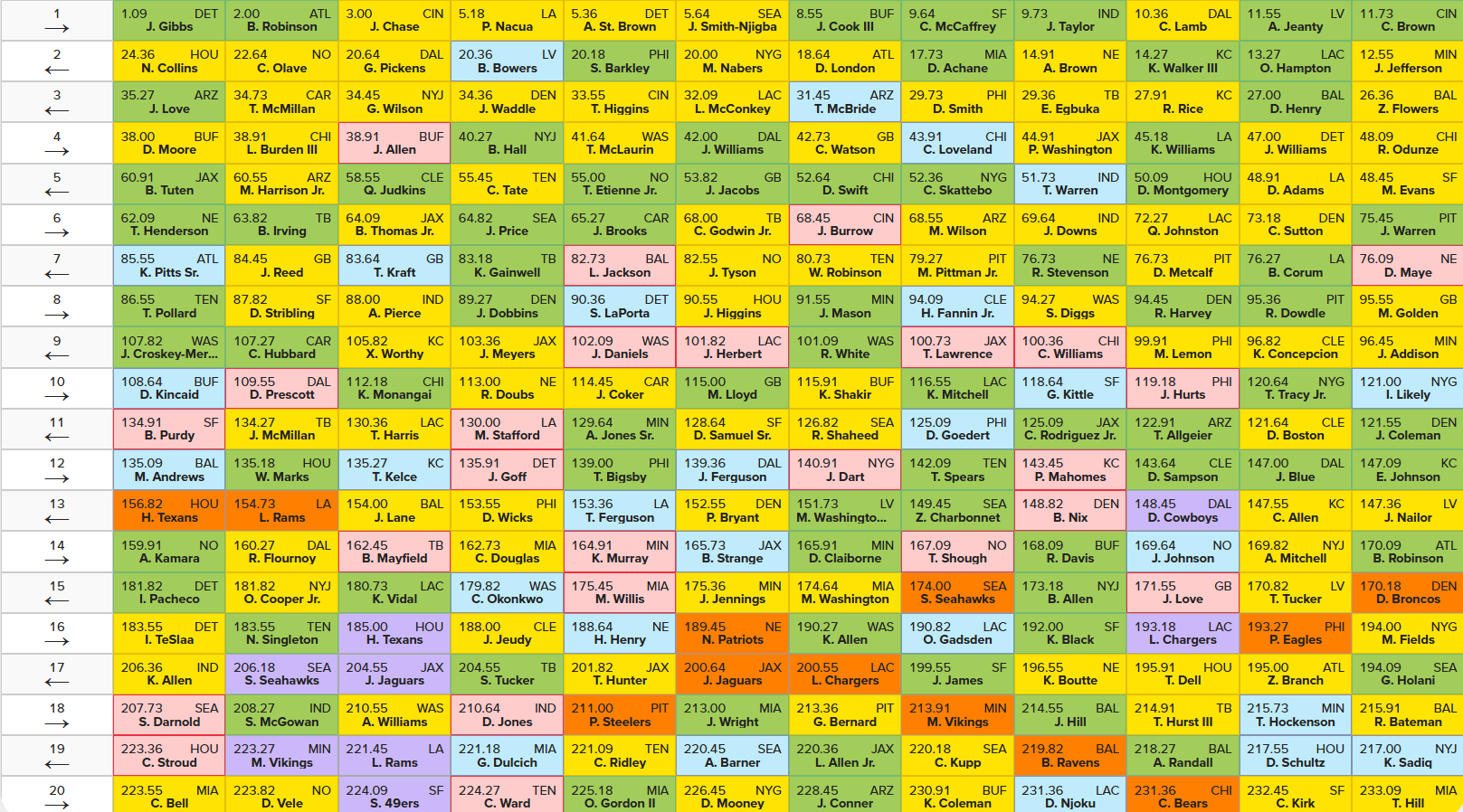
Here is an ADP board from mid-August. Obviously, every draft will be different, but we can learn some important lessons just by looking at the general trends here:
- Round 1 is nearly evenly split between RBs and WRs as managers look to anchor their teams with a stud
- During the 2nd Round, WRs begin to dominate, with 7 selections, vs. only four RBs
- Things really get skewed in the 3rd Round with nine WRs selected vs only four RBs. By the end of the round, WRs make up 58% of all drafted players. The ratio remains the same at the end of the 4th Round, and by the end of this round, we’re well into the WR3 tier while we’re just getting started drafting RB2s
- As the WR pool gets plundered, the balance begins to shift back to RB in subsequent rounds.s
- Still, at the end of eight rounds, 48 WRs are gone; an average of 4 per team. Only 36 RBs are off the board.
- At the QB position, Josh Allen doesn’t go until the 4th Round, and through eight rounds, only four QBs have been selected.d
- TEs actually disappear faster than QBs, with eight selected after eight rounds.
From all this, we see that drafters prioritize the best WRs over similarly-ranked RBs and even over elite QBs and TEs. This highlights a clear feedback loop that rewards drafters who follow the trend with better WR options for their starting lineups. RBs then begin to dominate as drafters can no longer ignore the growing disparity between diminishing returns at WR and presumably more stable and predictable points from the available RBs. From time to time, individual managers will be tempted by perceived enormous value at TE and/or QB.
You’ll probably like your teams best when you have at least 4 WRs and 2 RBs through the first 8 rounds. This gives you some flexibility to snag a value at TE or QB, but packing your roster with a couple extra RB/WRs adds resiliency and bye-week depth without sacrificing much, if anything, at QB or TE.
The biggest question is whether to follow the herd or be contrarian by taking early shots at other positions. The short answer: if you draft the right players, any strategy can work. If you draft the wrong players, even the best strategies fail miserably. If you have a crystal ball, you now know what to do. For the rest of us, read on!
Following The Herd Or Going Maverick
The safest strategy in any draft is to follow the herd. By focusing your efforts on WR and RB early, you’ll have plenty of options at arguably the most important two positions on your roster. We draft them early and often because we must start 3 WRs and 2 RBs, plus a flex, which is often filled by one of those positions. That’s up to 60% of our weekly starting lineup. Fall too far behind in drafting WR or RB, and you might find yourself not fighting to fill out a decent starting lineup, never mind a league-winning lineup. Only 2 teams will win money in each league, and only those 2 teams are guaranteed to advance to the shootout. Following the herd is the most likely way to stay in contention.
Mavericks follow a higher-risk strategy in search of higher rewards. They still have to be a top-2 team to advance to the championship round, of course. But if they can advance, they might have an easier path to winning the big money because of their unique build. Every year, a handful of players have enormous influence on which teams advance to the championship round. Due to static ADP in the early rounds, certain combinations of these players often appear together on the same teams. Maverick teams naturally differentiate themselves from these common player clusters because they built their teams differently in the draft.
What’s The Plan, Coach?
Back in 2013, when wide receiver Riley Cooper asked Philadelphia Eagles head coach Chip Kelly what the team’s plan was during a hard-fought game, Kelly bluntly replied, “F—ing score points. What’s your plan?”
And that, my friends, is the goal we can never lose sight of. Everything we do to build our team must be aimed toward this one objective. Don’t get sidetracked by “consistency” or any other made-up metrics. Just roster and start players that f—ing score points. Lots of points. The rest will take care of itself. The easiest way to advance to the championship round is to be the highest-scoring team in your league. Any other path requires some lucky bounces.
League-winning players generally have some traits in common:
- They play on a high-powered offense
- They touch the ball a lot and/or get lots of targets
- They score a lot of touchdowns
- They touch the ball often in high-leverage situations
We find almost all of these players in the first 10 rounds of our drafts. You have an excellent chance to advance if you draft well early and don’t run into bad injury luck. In 2024, I had the highest-scoring team in the entire tournament through the first 14 weeks. None of the players I drafted in rounds 11-20 contributed significantly to my team. Even my kicker and defense didn’t survive long on my roster before I replaced them with better options. That doesn’t mean you should jail it in over the last half of your draft, though. Sometimes you’ll find that diamond in the rough.
Touchdowns and receptions will take you much farther than passing yards and rushing yards. If you draft a bunch of players who run wild between the 20s but rarely score, it’s going to be hard to win your league. If they play for teams that don’t get into scoring range very often, it’s hard for them to become a key player for you.
The other takeaway of the Score F—ing Points plan is that ceiling matters a lot more than floor when it comes to any player’s weekly scores. Rostering and starting players who might get you 20+ points but might only get you 5 points is much better than rostering players who “usually” score 10 points but rarely get more than 13-14 points. High-floor players with no ceiling give the very best odds of finishing out of the money. Spike weeks are the lifeblood of winning tournaments.
The Elite TE Trap
Going maverick in one of these drafts potentially gains a positional advantage at either TE or QB. So let’s look at the TE data first. Is it worth it to use an early draft pick on TE in this contest? The answer is a qualified “maybe”.
Harder to find than you might think, the search for an elite TE might actually hurt your yearly total score more than it helps. Over the past five years, only 6 TEs have scored more than 250 points. In contrast, there have been 46 RBs and 45 WRs to crest that total during that same time span. So in an average year, 19 players will score 250: 9 RBs, 9 WRs, and only 1 TE.
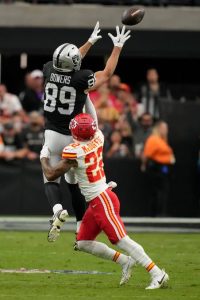
If we want to score as many points as possible, I like my odds of hitting one of those 18 RBs or WRs better than my odds of finding the single TE who can top 250 points. You might argue that it’s easier to spot that elite TE than it is to spot one of those RBs or WRs by the middle of the 2nd round. After all, TE1 Brock Bowers goes around the mid-2nd round, after selecting approximately 18 RBs and WRs. If we’re confident Bowers finishes as the overall TE1, that could make sense. But we also know that around half of those RBs and WRs will bust, which means plenty of candidates can still score 250 at those positions. And we also know that it’s far from a sure thing that Bowers will be the TE1.
When you pit the opportunity cost of selecting an early TE against the potential reward, taking a TE early becomes a risky proposition. Part of the opportunity cost is that the overall RB1 or WR1 might still be available. Over the past 5 years, the overall RB1 averages 385 points, and the overall WR1 averages 398 points. The average TE1 averages only 285 points. So you might be passing up 100 extra points by taking the TE.
Additionally, there’s an average of five RBs and five WRs scoring more than 285 points each year. Your odds of hitting one of them are better than your odds of nailing the top TE. So not only are your odds of hitting a 285-point player better by taking a RB or WR, but those players also have a higher ceiling than the TE1.
Clearly, going the elite TE route isn’t likely to improve your total team score. So why would anyone do it? Overconfidence in their ability to predict the identity of the overall TE1 pushes many drafters to take the plunge. That’s a poor reason. The better reason is that the TE that you select might be the key player you need to win the championship round and bring home that massive grand prize.
If you are building a portfolio of teams, taking some shots at elite TE makes more sense. If you’re jutering one or two teams, the odds favor loading up on RBs and WRs and taking your shots at TE later. There’s one advantage of taking a couple of shots at TE in the mid-rounds rather than swinging for the fences early. If you manage to roster two quality TEs, you can always put one in your flex. It’s easier to find a flex-worthy TE in the 10th to 14th rounds than to find an RB or WR to flex in that same range.
Is Elite QB Worth It?
Prices for elite QBs have never been lower in this contest. Josh Allen often lasts well into the 4th Round. Whoever goes as the 2nd QB off the board (usually Drake Maye, Lamar Jackson, or Joe Burrow) often lasts until the 7th round. It’s not unusual for the draft to roll into the 9th Round with only those four QBs selected. At these prices, it’s hard to fault anyone for veering off track to scoop one of these values.
For those who wait, the advantage is rostering an extra RB or WR pick before the cliff comes at those positions. The cost is easy to bear, too, with QBs like Justin Herbert, Caleb Williams, Trevor Lawrence, Jayden Daniels, Jalen Hurts, or Dak Prescott still available in the 9th and 10th rounds.
Your decision might hinge on what sort of stacks you want to build. Cheap QBs make stacking easy, with plenty of options available. Combined with cheap TE prices, it’s a snap to put together a QB, WR, TE stack of your choosing. And make no mistake, a good stack could be the key to winning the tournament. At the very least, it could pave the path to a league championship.
The ADP Traps
This article focuses a lot on ADP, and rightly so. If you fail to use ADP to your advantage, you’re likely to reach for your favorite players too often. Knowing ADP helps bargains come to you and lets you recognize them when they happen. Just don’t let an ADP value force you to make a bad pick. If the player or the position he plays doesn’t fit your needs at your current pick, don’t let ADP bully you into taking him.
We often say that we don’t hate players; we hate ADP. Profitable high-stakes players think differently. They recognize that some players are a bad value no matter how cheap. We want to avoid the roster-cloggers who have very little upside but just enough hope to keep us from dropping them. The ideal roster contains only players that we feel very good inserting into our lineup or players with a very high contingent value. Khalil Shakir is a classic roster-clogger (my apologies to his mother), while MarShawn Lloyd is currently one injury away from being a potential bell cow RB for a team that loves to run the ball. I know which player I’m taking in the 10th round of my draft!
MarShawn Lloyd is fully healthy and scoring TDspic.twitter.com/ZOIfD6L9ku
— Underdog NFL (@UnderdogNFL) August 22, 2026
The other trap set by ADP comes early in the draft. The earliest rounds of the draft are often highly predictable as most drafters agree on how to rank these players. Take a big step back, though, and think about this through a different lens. Let’s say you like Justin Jefferson a lot, and you think George Pickens will outscore CeeDee Lamb. If you are at the back end of the snake and blindly follow ADP, you will never get Pickens on your team, as he always goes in the late 2nd round. But by forcing Pickens up to be your pick in the early 2nd round, you can put together a unique build. If you’re that high on Pickens, there’s minimal downside to taking him 6-10 picks before his ADP.
Thinking out of the box leads to pairings that could give you an edge in the championship round. You’ll need the willpower to ignore the snickers of leaguemates who are slaves to ADP, though. You could pair Chase Brown and Saquon Barkley, who live at opposite ends of the snake. Maybe you could put CeeDee Lamb and George Pickens together, building a Dallas superstack. Don’t be afraid to go against the grain if you have conviction in your players.
When the Chiefs met Ceedee Lamb and George Pickens last season 👀 pic.twitter.com/9en4J5VpVe
— Football Performances (@NFLPerformances) May 17, 2026
Often in the final days of drafting before the NFL season, veteran high-stakes players will push players far earlier than their usual ADP to fill their portfolio with players they believe can win a championship. They don’t want to risk losing that player to another team. If you have real conviction on a player, don’t play games with ADP. Go get your guy.
Putting It All Together
There are a lot of ways to put together a winning roster in this tournament, but there are even more ways to put together a bad one. Keep yourself focused on the basics:
- When in doubt early in the draft, the best strategy is to load up on WRs and RBs
- Total points matter more than consistency, bye weeks, or anything else
- Taking a TE early is a potentially costly mistake
- Take advantage of historically cheap QB prices
- Build at least one stack with your AQB if possible
- Use ADP as a guide, but don’t let it limit your creativity
- Don’t play ADP games with a player you think could be a tournament winner
- Your goal is to “Score F—ing points!”
One final word of advice. Draft as if every pick you make is exactly right. It’s OK to recognize a weakness at any position and address it. But don’t go crazy handcuffing all your early RBs or make any other picks that limit your upside. Now go draft a winner!
For more articles from PlayerProfiler, check out the fantasy home page – NFL Fantasy | PlayerProfiler – Fantasy Football News & Media