Guillotine fantasy football breathes new life into the game for those who feel that regular redraft leagues don’t get it done anymore. If you haven’t heard of it, you can check it out here. Managers get eliminated weekly, the waiver wire is always juicy, and every Sunday and Monday night someone is fighting for their life.

If you’re not playing guillotine, you should probably try it. And if you are, maybe you should be playing even more. If you want to start or add more leagues to your list, you need to start your year off on the right foot.
Too many managers walk into a guillotine draft with their normal rankings, push down the injured players and rookies, and call it a day. We can do better than that with this guide to guillotine draft strategy.
PlayerProfiler is home to award-winning dynasty rankings and tools. Our Dynasty Deluxe package includes complete Dynasty Rankings, Rookie Rankings, Trade Analyzer, Draft Planner, Mock Drafts, and more. Check it out right here!
Guillotine Strategy 101 | A Manager’s Companion Guide
Two Wrongs Don’t Equal a Right | Stop drafting the stacks!
Joe Burrow paired with Ja’Marr Chase is obviously a nightmare matchup to go head-to-head against, but the variance the pair would inject into your lineup is prohibitively high in this format. An explosive game from them will only truly save your season when the rest of your team lays some eggs.
On the flip side, one bad Burrow game takes Chase down with him, and your team could be staring at elimination. Even the most advantageous stacks for best ball don’t carry the same value in a league where one bad game can get you booted.
Without Stacking, Cover Your Bases | Draft skill players in the same offensive attack
In guillotine draft strategy, floor-raising plays matter a ton. If you take one half of an ambiguous backfield, drafting the other half doesn’t feel sexy. However, it means that if one half has a dud, the other half is likely to perform well.
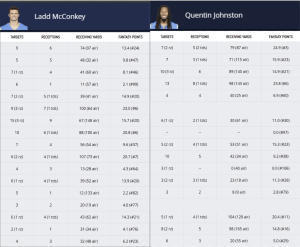
One can say the same of wide receivers on the same team. Ladd McConkey and Quentin Johnston, for example, scored 20 points between the two of them every week last season until the Chargers offense hit the wall.
Don’t Await An Invite | Draft a quarterback earlier than usual
Joe Burrow with the season on the line:
39/49
412 passing yards
4 total TDs pic.twitter.com/wjAM5a7Ryy— NFL (@NFL) December 29, 2024
The late-round QB was a revolution to the fantasy game, no question. This is a different format, though. Every team will leave their draft with a weakness. You could leave the draft with a weakness at tight end, players who rarely score well outside of the top few anyway. You could leave with a weak flex or RB2, of which there will be several waiver options throughout the year.
Or, you could leave with a weakness at the position that scores the most points, in a format where you literally only need to avoid scoring the fewest. The choice is yours.
Everyone Deserves a Day Off | Pay more attention to BYE weeks
Jahmyr Gibbs and Ja’Marr Chase are consensus top picks at their positions, but neither play football in week 6. Compare that to Bijan Robinson and Puka Nacua, whose BYE weeks aren’t until week 11, when your waiver wire will be swimming with solid replacement players. Gibbs and Chase will put you behind the 8-ball a little too early in the season to justify top-3 selections.
Come With a Plan | Look at the early-season schedule before you draft
Take Emeka Egbuka, for example. His hot start last season will prove difficult to replicate. He plays 3 top-5 defenses against fantasy wideouts in the first 3 weeks of the season. Garrett Wilson, who goes right after him in drafts, plays 3 bottom-10 units in his first 4 games! And the 4th game comes against a Packers team that may not field Micah Parsons to start the season.
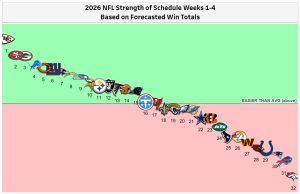
Via Sharpfootball on Twitter
There’s a more in-depth look at the updated projections, including some comments about opponents and overall rest advantages RIGHT HERE.
It’s Rare to Score Big on Breakouts | Don’t draft project players. Ever.
This may be the most important strategy on the list. Every year, managers fall in love with a rookie or second-year player who needs time to develop. Luther Burden exemplified this in 2025; he finished the season strong, and now we love him.
Only one problem: Burden was a horrible guillotine draft choice. It wasn’t until Week 13 that he saw more than five targets in a game. By the time we knew Burden was a good player, your league was far too concentrated for him to be startable.
Plenty of exciting players fall into that category this year as well. Think Malachi Fields, Zachariah Branch, Ja’kobi Lane, and Elijah Sarratt for the Ravens. Your late picks are better spent on players who you can cut without remorse, rather than the Burdens of the world who demand months of burning a roster spot most of the campaign to justify a draft choice.
Jakobi lane 8 catches for 100 yards gonna feed families every week pic.twitter.com/NbWuHOnCx2
— John (@iam_johnw) August 16, 2026
Guillotine leagues offer little reward for being right about a polarizing player relative to other formats. However, they certainly punish being wrong about such a player more heavily than the rest. My best advice? Don’t draft like you’re the smartest drafter in the league. If you follow the steps laid out above and don’t get a big head about who’s going to have a huge breakout, you should do great.
Admittedly, you may not have the flashiest draft in the league, but it won’t be the “trashiest” either. When half of your league is eliminated because their favorite rookie breakout candidate took a few weeks to acclimate to the NFL, or their unbeatable Tyler Shough–Chris Olave stack gets steamrolled by the Vikings in Week 4, you’ll find yourself pretty excited to have looked into some guillotine draft strategy a couple months ago.
Thanks for reading, and good luck this season.
 YouTube