“In this world there’s two kinds of people, my friend: those with loaded guns and those who dig.” — Clint Eastwood
In the NFL, there are three kinds of injury comebacks: The Good, The Bad, and The Ugly.
Some players defy expectations and return to form. Others struggle to regain their footing after injury. And some leave fantasy managers digging for answers.
From George Kittle’s Achilles recovery to Jeremiyah Love’s ongoing ankle concerns, I want to examine seven players who entered the season with injury question marks and determine how their recoveries are shaping their fantasy outlooks.
PlayerProfiler is home to award-winning dynasty rankings and tools. Our Dynasty Deluxe package includes complete Dynasty Rankings, Rookie Rankings, Trade Analyzer, Draft Planner, Mock Drafts, and more. Check it out right here!
The Good, the Bad and the Ugly | Injury Comebacks
George Kittle, TE (49ers) – Achilles
Entering the 2026 season, George Kittle was coming off a devastating Achilles rupture suffered on January 11, 2026. Achilles injuries can be among the most career-changing injuries an athlete can suffer. The Achilles tendon attaches the posterior leg muscles to the foot, allowing for plantarflexion, which is critical for push-off during acceleration and cutting. There were legitimate questions surrounding his availability and ability to return to his previous level of play.
Those concerns were justified. A 2024 systematic review published in Foot & Ankle Orthopaedics examined NFL players following Achilles tendon ruptures and found a return-to-play rate of just 66.2%, with players returning at a weighted mean of 10.9 months after injury.
However, Kittle has thus far defied the odds, returning in an impressive eight-month time span. Through six games, Kittle has recorded 26 receptions for 337 yards and five touchdowns. Not only that, Kittle also defied concerns about whether he could return to being the explosive yards-after-catch (YAC) weapon fantasy managers are used to seeing. He has posted an impressive 173 YAC, second-most among tight ends, per PlayerProfiler data.
For fantasy managers, the early returns are difficult to argue with. Kittle has quickly reestablished himself as a high-impact option at a position where consistent touchdown production can create a meaningful advantage. His recovery remains worth monitoring, but his performance so far has exceeded what many would have expected from such a short turnaround.
The Verdict: THE GOOD
Kittle has returned from a major Achilles injury and immediately resumed producing at a high level. While the long-term outlook still warrants monitoring, he is providing fantasy managers with an encouraging example of a successful return to play.
Quinshon Judkins, RB (Browns) – Ankle
Quinshon Judkins entered the 2026 season looking to build on a promising rookie campaign that was cut short by a significant ankle injury. In Week 16 of the 2025 season, Judkins suffered an ankle dislocation and fractured fibula that required surgery on December 23.
Dislocations can vary significantly in severity depending on the damage to surrounding ligaments and other structures. In Judkins’ case, the reported extent of ligament damage is an important consideration when evaluating the complexity of his injury. However, even if significant ligament damage was avoided, the associated fibular fracture remained a major component of his recovery.
The fibula plays an important role in ankle stability. Its distal end forms the lateral malleolus, which helps maintain the ankle mortise and properly position the talus beneath the tibia. Depending on the fracture location and pattern, a fibular fracture can compromise this stability and the ankle’s ability to tolerate high loads.
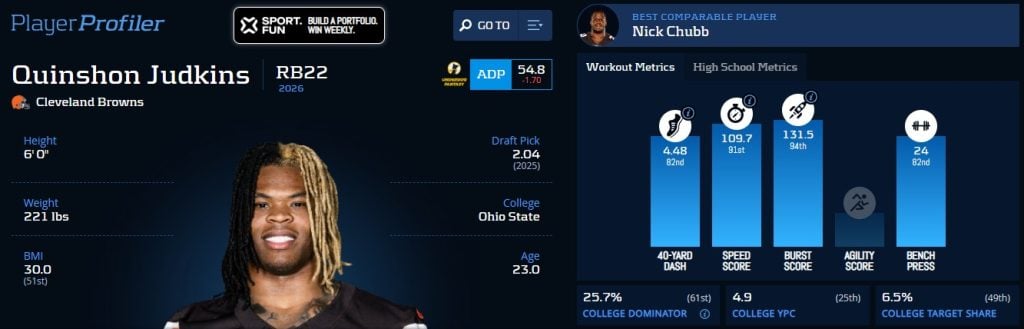
Judkins’ early-season production alone does not establish that he is experiencing residual limitations from his previous injury. Offensive line performance, defensive matchups, scheme, and other variables can all influence rushing efficiency. Nevertheless, his subsequent ankle injury in Week 5, which caused him to miss practice and ultimately sit out Week 6, added another layer of uncertainty.
Through his first five appearances of the 2026 season, Judkins averaged approximately 3.0 yards per carry, leaving fantasy managers wanting more after his rookie campaign. His rushing efficiency has declined compared with 2025, and the subsequent ankle setback further complicated his outlook.
The key question is whether Judkins can regain consistency and maintain availability as the season progresses. His production does not prove that his original injury continues to limit him, but the combination of inefficient rushing and another ankle issue makes his outlook less reassuring than fantasy managers had hoped.
The Verdict: THE BAD
Judkins returned from a significant ankle injury, but his early-season production and subsequent setback have created new questions about his consistency and availability.
Jeremiyah Love, RB (Cardinals) – High Ankle
Jeremiyah Love entered his rookie season with high expectations after being selected No. 3 overall in the 2026 NFL Draft. However, an ankle injury suffered during his only preseason appearance derailed the start of his rookie campaign.
Ankle sprains vary considerably in severity depending on the structures involved. High ankle sprains, which affect the distal tibiofibular syndesmosis, can be particularly challenging for athletes because these structures help maintain stability between the tibia and fibula during weight-bearing activities.
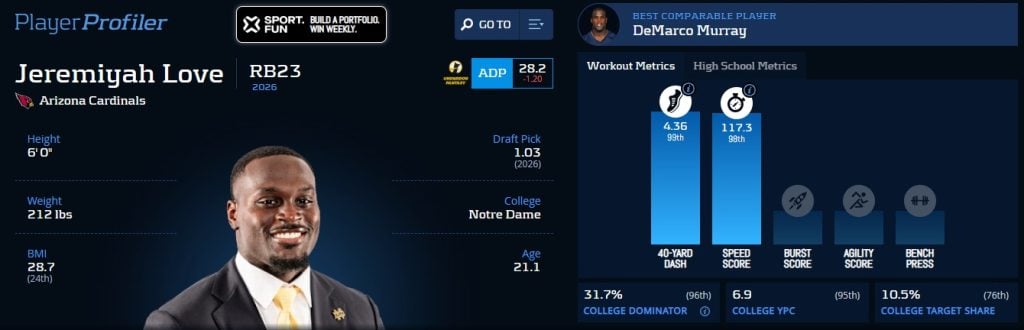
Love initially appeared to be moving in the right direction. Through his first four regular-season games, he showed flashes of the explosive playmaking ability that made him a top-three selection. However, he began experiencing another ankle issue, separate from the one he sustained during the preseason. Although he continued playing, his ability to contribute appeared to wane, and he recorded just 22 rushing yards on 12 carries against Detroit in Week 5.
The most concerning development came afterward. Love missed Week 6 with the lingering ankle issue, and he’s out for Week 7 as well. Cardinals head coach Mike LaFleur explained that Love’s aggressive cutting ability was being affected, specifically when planting his foot. He also noted that the team wanted to get Love healthy enough to contribute more consistently in both the running and passing games.
The Verdict: THE UGLY
Love has already demonstrated the upside that made him such an exciting fantasy prospect, but recurring ankle problems have interrupted his rookie campaign before he could establish a consistent role. Until he can return to the field and cut confidently without further setbacks, both his short-term production and availability remain difficult to trust.
Malik Nabers, WR (Giants) – ACL
ACL reconstruction is a major undertaking for any athlete, but wide receivers must regain more than the ability to run in a straight line. Route running requires repeated acceleration and deceleration, sharp changes of direction, and the ability to plant and push off one leg while creating separation from defensive backs. These movements place substantial demands on knee stability, strength, and neuromuscular control. An associated meniscus injury can add further complexity to the rehabilitation process.
Malik Nabers’ return was not entirely straightforward. As the 2026 season approached, questions remained about whether he would be ready for Week 1, and reports indicated that he underwent an additional procedure in the offseason to address scar tissue affecting knee flexibility.
Complicating matters further, the New York Giants QB situation took a turn for the worse after teammate Jaxson Dart was ruled out for the season after injuring his knee as well.
Through six games, Nabers has delivered the kind of production fantasy managers hoped to see. He has recorded 41 receptions for 494 yards and two touchdowns, including three consecutive games with more than 100 receiving yards from Weeks 4 through 6. His 165-yard performance against New Orleans in Week 6 was particularly encouraging, demonstrating that he can still produce at an elite level following a major knee injury.
The Verdict: THE GOOD
Nabers has returned from a significant ACL and meniscus injury and has quickly reestablished himself as a focal point of the Giants’ passing attack. His early-season production is an impressive outcome, particularly given the demands of his position and the complexity of his rehabilitation. Although continued health and performance remain important to monitor, Nabers has given fantasy managers plenty of reason for optimism.
Alec Pierce, WR (Colts) – Foot
Alec Pierce entered the 2026 season following a career-best campaign in which he recorded 1,003 receiving yards and six touchdowns. His breakout performance earned him a massive four-year contract extension with the Indianapolis Colts worth approximately $114 million, with $84 million guaranteed.
However, that investment was quickly complicated by an ongoing heel issue. Pierce underwent surgery in the spring after playing through heel pain during the 2025 season. The procedure limited his offseason participation and much of training camp, raising questions about whether he would be ready to contribute at full capacity.
Pierce underwent what was deemed “a clean-up” procedure of his foot. An arthroscopic procedure is a minimally invasive surgical technique in which a small camera and specialized instruments are inserted through small incisions to visualize and treat the affected area. Depending on the underlying pathology, surgeons may remove inflamed tissue, loose fragments of bone or cartilage, or bone spurs that contribute to pain and restricted movement.
Although Pierce returned for the regular season, the recovery process was far from complete. After appearing in Indianapolis’ first two games, Pierce aggravated the surgically treated heel against Kansas City in Week 2 and was subsequently placed on injured reserve.
#Colts HC Shane Steichen says WR Alec Pierce, who is eligible to come off IR this week, will not practice. He’s still rehabbing after aggravating his surgically repaired left heel last month.
No surprise on that front. Pierce was in a walking boot yesterday in the press box.
— James Boyd (@RomeovilleKid) October 19, 2026
It is important not to assume that this setback means the original surgery failed or that Pierce necessarily sustained additional structural damage. Without more specific diagnostic information, the exact cause of his continued symptoms remains unclear. His return timeline also remains uncertain, and given the prolonged absence and lack of progress toward returning to practice, a return in the immediate future appears unlikely. For fantasy managers, this creates significant uncertainty surrounding his availability and ability to contribute consistently during the remainder of the 2026 season.
The Verdict: THE UGLY
Pierce entered the season with a new contract and expectations of building on his first 1,000-yard campaign. Instead, a recurring heel issue has limited him to two appearances and left his availability uncertain.
Michael Penix Jr., QB (Falcons) – ACL
Michael Penix’s injury history makes this recovery particularly notable. During his college career at Indiana, he suffered two ACL tears in his right knee, requiring reconstructive surgeries in 2018 and 2020. In November 2025, he sustained a partially torn ACL in his left knee, marking his third ACL reconstruction. Although the latest injury occurred in the opposite knee, his history of multiple reconstructions adds important context to the complexity of his rehabilitation.
The latest surgery also presented a unique challenge. Penix had previously used both patellar tendon grafts for his earlier ACL reconstructions, meaning surgeons could not use either tendon again for the latest repair. Instead, they used a quadriceps tendon graft and performed an additional procedure on the lateral side of his knee to help address stability. This made his latest operation more involved than a straightforward ACL reconstruction.
The Atlanta signal-caller took a cautious approach to his return. Although he participated in offseason workouts and training camp, he was not cleared for full-team work until late August. He also acknowledged that he did not feel ready to play during the first two weeks of the regular season. Rather than rushing back, Penix waited until he felt confident that he could perform at the level required to help his team.
Michael Penix Jr. has now played 4 games since his ACL tear this season for the #Falcons. Tale of 2 different teams it feels like with the offense. pic.twitter.com/bcEboCMesa
— Joe Cronin (@Joe_cronin03) October 20, 2026
That patience appears to have paid off. In his first three starts of the 2026 season, Penix completed more than 65% of his passes for 719 yards, three touchdowns, and one interception. Atlanta went 2-1 in those games, providing an encouraging early return from a rehabilitation process that extended well into the regular season.
His decision to wait until he felt ready also highlights an important aspect of rehabilitation: returning to competition should be based on functional readiness, not simply the number of months since surgery.
The Verdict: THE GOOD
Penix has overcome another significant knee injury and returned to the starting lineup, showing encouraging early production despite an extensive history of ACL injuries. His long-term durability remains a reasonable concern, but his return to competitive play represents a meaningful step forward in a career repeatedly interrupted by injury.
Cam Skattebo, RB (Giants) – Ankle
Cam Skattebo‘s promising rookie campaign was abruptly cut short by a devastating ankle injury. In Week 8 of the 2025 season, he suffered an ankle dislocation, an open fracture involving the tibia and fibula, and a ruptured deltoid ligament. The injury required emergency surgery and ended his rookie season after eight games.
The severity of this injury extended beyond a typical ankle sprain or isolated fracture. The deltoid ligament is a major stabilizer on the medial side of the ankle, helping resist excessive eversion and maintain alignment between the talus and the lower leg. Meanwhile, the tibia and fibula form the structural framework that transfers forces between the foot and the rest of the lower extremity. An ankle dislocation combined with fractures and ligament disruption represents a complex injury involving multiple stabilizing structures.
Despite the severity of the injury, Skattebo made it back for the Giants’ 2026 season opener. His return was an encouraging milestone, particularly given the complexity of the original injury and the surgery required.
His early-season production has been less encouraging. Through his first six appearances of the 2026 season, Skattebo recorded 294 rushing yards on 84 carries, averaging approximately 3.6 yards per attempt. He also struggled with ball security, fumbling four times and losing one. Following those issues, his role became less secure, and he played only six snaps in Week 6 as the Giants considered changes to their backfield rotation.
For fantasy managers, the concern is the gap between Skattebo’s potential and his current role. He already demonstrated that he can return to NFL competition after a major injury, but returning to the field and immediately regaining his previous level of performance are two different things. Until his production and workload become more consistent, his fantasy outlook carries more uncertainty than anticipated.
The Verdict: THE BAD
Skattebo’s return from a complex ankle injury was an important achievement, but his early-season rushing efficiency, ball-security problems, and reduced playing time have complicated his sophomore campaign. His current performance does not prove that the injury continues to limit him, but fantasy managers need to see greater consistency before confidently expecting him to return to his previous level of production.
Maddox McCloud is the resident fantasy football injury analyst for PlayerProfiler.
Follow @MaddoxMcCloudPT