FastDraft is the premier way to play best ball, with full-season, weekly, and rookie-only tournaments. Download the app right here, and start drafting faster. You can use the promo code “FAST” and get a deposit match of up to $50! “Way-too-early” tournaments are already in full swing, including “The Rabbit” and the all-rookie “Origins” tournament!
Today, Branden Levine drops his analysis of the various iterations of “Origins” in 2025, including what consistently worked and what didn’t. Could last season have provided a cheat code?
PlayerProfiler is home to award-winning dynasty rankings and tools. Our Dynasty Deluxe package includes complete Dynasty Rankings, Rookie Rankings, Trade Analyzer, Draft Planner, Mock Drafts, and more. Check it out.
The 2025 “Origins” Meta: What Actually Mattered
I went back and ran a full cross-tournament breakdown on 2025’s “Origins” tournaments: Alpha, Chaos, Chaos 2, and Gamma. The point is to look for trends that held up across all four contests and to filter out as much single-tournament noise as possible. The real question isn’t “What won Gamma?”, it’s: “What held up across the board?”
- Draft Slot 1 was a real advantage: Top 3 in average points in four out of four tournaments, best overall in three of four.
- This format was tight-end-driven: TE count was positively correlated with scoring in each tournament, whereas the wide receiver position was negatively correlated across all tournaments.
- There was a clear ‘engine’: Player cluster (particularly Jaxson Dart paired with Harold Fannin Jr.).
- Being contrarian did not provide a winning edge.
Takeaway No. 1 | Draft Slot 1 Was a Real Advantage
Average Total Points by Draft Slot
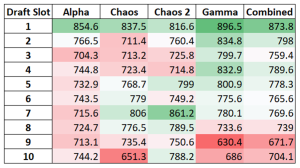
The No. 1 draft slot crushed
The top spot in the draft finished top 3 in average total points in all four tournaments, and was the best overall slot in three of them. That’s about as clean as it gets. Slot 1 being strong isn’t some new revelation; in most tournaments like this, No. 1 tends to be above average at the very least, but the data fully reinforces it here in 2025 “Origins.”
Bottom line: Slot 1 wasn’t just “nice to have.” It was a structural advantage in the tournaments.
Takeaway No. 2 | 2025 “Origins” Best Ball Was Tight End-Driven
Correlation of Positional Count vs. Total Points
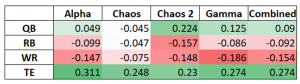
Average number of each position per team for Top 50 teams vs. All other teams (“Rest”)

This was the most consistent roster construction signal across all four tournaments, and when I looked at the correlation of positional count vs total points, the direction was the same every time:
- TE count | Positive correlation in 4/4 tournaments (combined correlation +0.274, range roughly +0.23 to +0.31 depending on the tournament)
- WR count | Negative correlation in 4/4 tournaments (combined correlation -0.154)
- RB count | Mildly negative (combined -0.092)
- QB count | Mildly positive (combined +0.090)
In these six-round rookie tournaments, being heavier at tight end was +EV (expected value) and being heavier at wideout was -EV across the board. Running back and quarterback mattered less from a “how many did you draft?” standpoint. When you check that against actual roster builds, it lines up.
If you look at the top 50 teams vs everyone else, the top 50 builds were heavier at tight end, and lighter at wide receiver in every one of the tournaments. From a combined roster drafting standpoint, in terms of the upper class versus the non-competes,
- The top 50 teams averaged 1.04 TE vs. just 0.74 TE for the rest
- The top 50 teams averaged 1.56 WR vs. 2.12 WR for the rest
Bottom line: A clear signal of what worked well when drafting from the 2025 rookie class.
Takeaway #3: The ‘Engine’ Players Were Pretty Clear (Dart with Fannin Was the Stack)
Jaxson Dart 7 Starts, 1417 PYDS, 17 Total TDs, 3 INTs, 62.7 CMP%, 317 RUYDS. 2025 Mid Season Highlights.
This kid is special. https://t.co/uC5HLWXhGo pic.twitter.com/O8DQt5IKFL
— Football Performances (@NFLPerformances) November 11, 2025
Top 100 Appearances by Player
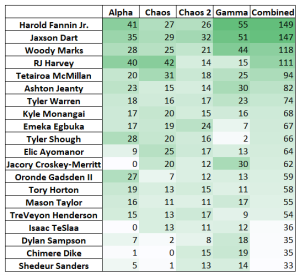
Cross-tournament top pairs by combined top 100 frequency
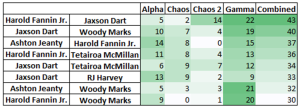
When I looked at the top 100 appearances by player across all four tournaments, three guys were the true cross-tournament constants: Dart, Fannin, and Woody Marks. Those were the only players that were basically “must-haves” across all four tournaments, as they were heavily represented in the top 100 builds in every tournament.
RJ Harvey also popped up a ton overall, but he was more of a tournament-window dependent league-winner; massive in “Alpha” and “Chaos,” less universal across all four. This is likely due to the spike in ADP after he was a somewhat surprising second-round pick in the NFL Draft, allowing drafters who drafted him prior to the NFL Draft to capitalize on strong closing-line value, while he performed modestly compared to his draft price post-NFL draft.
The pairing data makes the story even clearer. The most common top-100 pair across the four tournaments was Dart and Fannin (43 combined top-100 pairings), and then you see obvious extensions into the other core names (Marks, Tetairoa McMillan, Ashton Jeanty, Harvey, etc).
If the #Browns draft a WR1 that can consistently win on the perimeter
That only gives Harold Fannin more space to gobble up yards over the middle
pic.twitter.com/SgdtDtDyuW— Mac🦬 (@tha_buffalo) March 17, 2026
Bottom line: You didn’t need to “galaxy-brain” it. There was a very real ‘engine,’ and many top teams were just different variations of the same core.
Takeaway #4: Being Contrarian Didn’t Work
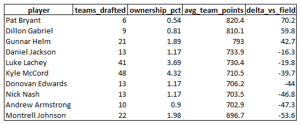
Contrarian Summary

“Chaos” Contrarian Analysis
“Gamma” Contrarian Analysis
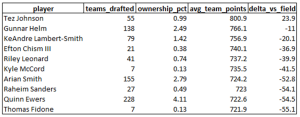
I looked at players rostered on less than 5% of teams and compared the average score of teams with those players versus the field. If there was a big “low-owned leverage” edge, you would expect it to show up most in “Gamma,” since it’s the biggest field. It didn’t.
In fact, “Gamma” had the weakest “best contrarian delta,” meaning among players drafted on less than 5% of teams, which teams that drafted them outscored the field average by the largest margin.
- “Alpha” best contrarian delta: +157.6
- “Chaos”: +70.2
- “Chaos 2”: +80.2
- “Gamma”: +23.9
There still were some low-owned guys who popped in small samples, but nothing screamed “repeatable edge.” The biggest tournament did not reward contrarian play more; it rewarded it less.
Bottom line: Uniqueness wasn’t the winning strategy. Getting the core right was.
What’s The 2026 Play?
If this format doesn’t change:
- Slot 1 is an advantage, so start praying to the fantasy gods.
- TE volume matters (I’m looking at you, Kenyon Sadiq).
- WR-heavy builds were structurally weaker. It will be interesting to see if this holds year-over-year.
- The core two to three breakout players drive everything.
The sharp move isn’t to out-think the room. It’s about getting the ‘engine’ right and then layering leverage behind it.
That’s it. Easier said than done.
For more articles from PlayerProfiler, check out the fantasy home page – NFL Fantasy | PlayerProfiler – Fantasy Football News & Media
Branden Levine is a fantasy analyst at PlayerProfiler. Track him down for more football takes and analysis @branden_levine