“Step by Step” isn’t just the highest-selling hit from the infamous New Kids on the Block of the late 80s/early 90s—it’s also a pretty good description of how you build a fantasy football team. You start with talent. Then add opportunity, and finally upside.
Hopefully, you put all the pieces together into a championship roster. Sometimes, however, there’s a step that fantasy managers overlook: Health.
The 2026 rookie class is loaded with players who could make an immediate impact. Still, several of the “new kids on the block” come with injury histories or current health concerns that could impact their development, workload, and ultimately, their fantasy value. Before you fantasy managers thrust them into their lineups, let’s take a closer look — step by step.
PlayerProfiler is home to award-winning dynasty rankings and tools. Our Dynasty Deluxe package includes complete Dynasty Rankings, Rookie Rankings, Trade Analyzer, Draft Planner, Mock Drafts, and more. Check it out right here!
Hangin’ Tough: 2026 Rookie Injuries to Monitor
Chris Bell | WR, Miami Dolphins
If there’s one thing fantasy managers love, it’s upside. If there’s one thing they hate, it’s uncertainty… Chris Bell brings plenty of both.
The Miami Dolphins selected Bell with the No. 94 overall pick in the 2026 NFL Draft, but his draft-day slide had little to do with his talent. The former Louisville standout tore his left ACL on November 22, 2025, ending his final college season and forcing him to spend the offseason rehabbing rather than preparing for the NFL Combine or his rookie campaign. He underwent surgery in December.
The rehabilitation process is more complex than simply waiting for the ligament to heal. Current return-to-sport literature emphasizes a combination of objective strength, functional performance, movement quality, and sport-specific testing before clearing an athlete.
For an ACL-reconstructed athlete, some of the key metrics include:
- Full Joint Range of Motion (ROM)
- Quadriceps Strength: Ideally, greater than 90% limb symmetry compared with the uninvolved leg.
- Hop Testing/Plyometrics: Commonly used to assess limb symmetry and functional performance.
- Movement Quality: Not just that an athlete can run or jump; it’s how they land and move. Knee stability, control, and the absence of significant compensation patterns are important.
- Sport-Specific Testing: Can the athlete tolerate the demands of their sport, including acceleration/deceleration, sprinting, cutting, and repeated high-intensity efforts?
Dolphins WR Chris Bell will be their WR1 before year-end
Man is running legit hitch routes, comebacks, go’s, and posts 8 months off an ACL as a sure-fire Top 50 pick pic.twitter.com/hWfwPM0HUB
— Clint Goss (@NFLDraftDome) August 31, 2026
For Bell, the question isn’t simply “Is his ACL healed?”; it’s “Is he physically ready to handle NFL football?”
Bell has made encouraging progress in his recovery, returning to practice after beginning training camp on the NFI list. But returning to practice is only one piece of the puzzle. After missing valuable offseason reps, Bell still has to regain his football conditioning while learning a new offense and competing for snaps. That’s where the fantasy concern comes in.
Bell has the talent and opportunity to become an intriguing rookie fantasy asset. Expecting him to immediately perform like the player he was before the injury may be overly optimistic. The ACL may be structurally healed, but I’ll be watching his strength, explosiveness, workload tolerance, and movement confidence.
Jordyn Tyson | WR, New Orleans Saints
If Bell’s story is about returning from one major injury, Jordyn Tyson‘s is about the pattern.
Tyson was selected No. 8 overall by the Saints after an impressive 2025 season at Arizona State, but his injury history was one of the biggest concerns surrounding him entering the draft. He missed significant time with a knee injury early in his college career, suffered a collarbone fracture in 2024, and dealt with hamstring problems in 2025.
Unfortunately, that concern followed him into the NFL. Tyson suffered another hamstring injury during training camp and is expected to miss approximately two months, potentially costing him the first several games of the regular season. Hamstring injuries are particularly concerning for wide receivers because high-speed running is both critical to the position and a common mechanism of hamstring injury.
A review by Dr. Anthony G. Schache et al. (2022), “Hamstring Injury … A Clinician’s Guide,“ emphasizes that rehabilitation should progressively expose athletes to increasing running speeds, eventually reaching high-speed and maximal sprinting before returning to sport. The authors also highlight the importance of managing high-speed running exposure as athletes progress through rehabilitation.
That matters for Tyson. Getting him pain-free isn’t the finish line. Before he can consistently handle an NFL workload, his rehab needs to progress from jogging to faster running to high-speed sprinting — and eventually to the repeated acceleration and deceleration demands of playing wide receiver.
For a player whose game depends on explosiveness and separation, being cleared to play and being physically ready to perform at full speed aren’t necessarily the same thing. Tyson’s talent isn’t the question; it’s whether his body can consistently tolerate the demands required to showcase it. He’s already dealt with multiple injuries throughout his college career, and now he’s facing another significant hamstring injury before playing a single NFL game.
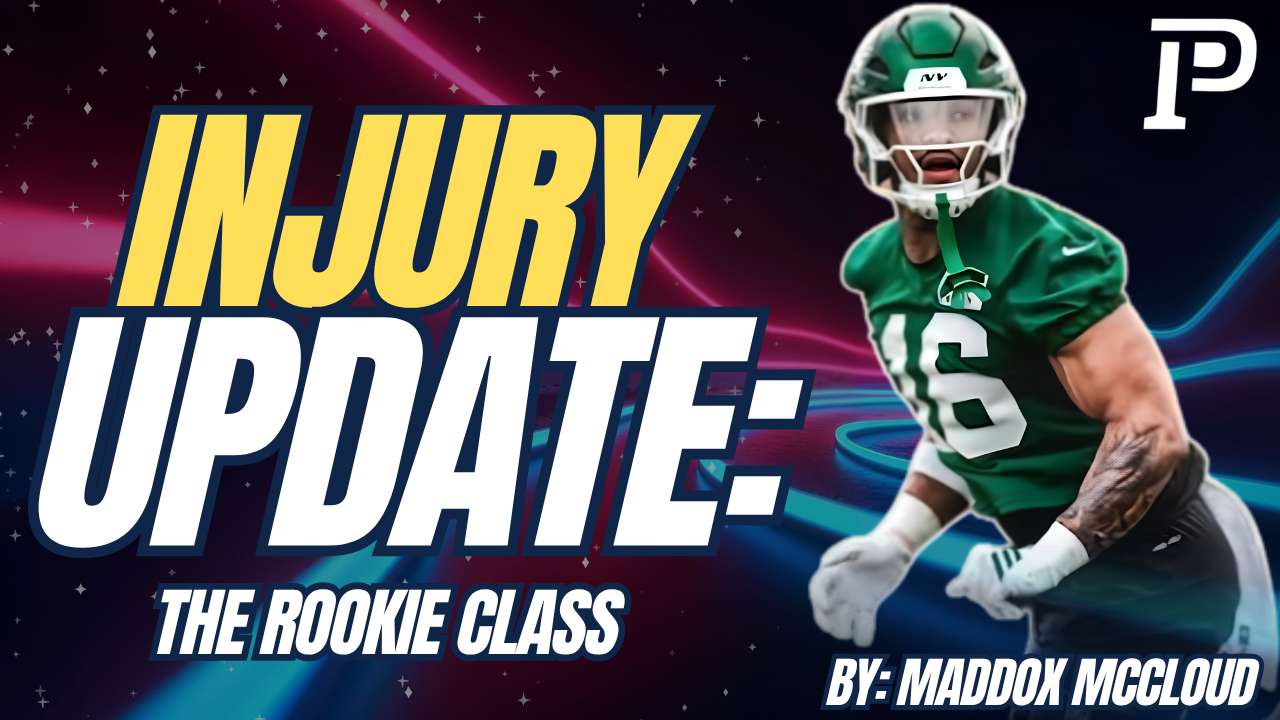
Kenyon Sadiq | TE, New York Jets
The Jets drafted Kenyon Sadiq 16th overall after an impressive final season at Oregon. And the athletic profile is almost impossible to ignore.

In other words, this isn’t a prospect whose fantasy upside is based on hype alone. The underlying athletic data backs it up. The problem is that Sadiq entered the NFL already dealing with a hernia that he played through during his final season at Oregon. He underwent a procedure during the offseason and subsequently missed valuable offseason work.
Then came another setback. Sadiq dealt with lingering groin/abdominal issues during training camp, costing him additional practice time and the preseason.
The term “sports hernia” can actually be misleading. According to Ellsworth, Zoland, and Tyler (2014), a sports hernia is not technically a true hernia in many athletes. The term is often used to describe athletic pubalgia or inguinal disruption— conditions involving the soft tissues around the lower abdomen, pubic region, and proximal adductors.
Why does that matter for Sadiq? The area is heavily involved in the movements required of an NFL tight end.
Athletic pubalgia can produce deep groin or lower-abdominal pain that is aggravated by sprinting, cutting, sudden changes of direction, and other high-intensity movements. The abdominal and adductor structures work together around the pubic symphysis. This makes the region particularly important for force transfer between the trunk and lower extremity.
For a tight end, that’s a pretty important piece of the puzzle. Sadiq doesn’t just need to run straight lines. He needs to accelerate, decelerate, change direction, block, absorb contact, and repeatedly generate force through his trunk and hips.
When I look at Sadiq’s injury, I’m less concerned about whether the surgical incision has healed and more interested in whether he can tolerate the repeated high-speed and high-force demands of football without symptoms returning.
Carson Beck | QB, Arizona Cardinals
Carson Beck was selected in the third round of the 2026 draft and made quite an impressive debut in the Hall of Fame Game, completing 15 of 19 passes for 188 yards and a touchdown.
Carson Beck deep ball!pic.twitter.com/VYnRgilXXN
— Underdog NFL (@UnderdogNFL) August 7, 2026
For a quarterback, rib injuries are worth monitoring because the ribs aren’t just there to protect the chest; they also contribute to trunk motion and respiration. From a physical therapy perspective, rib dysfunction can generally be thought of in a few ways:
- Structural: A true traumatic injury or subluxation.
- Torsional: Can restrict spinal and trunk motion while also affecting respiration.
- Respiratory: Can be influenced by poor posture and restricted breathing mechanics.
That matters for Beck because throwing requires coordinated trunk rotation, spinal motion, and force transfer, while playing quarterback also requires the ability to take contact and repeatedly generate force through the torso.
So the concern isn’t simply, “Can Beck throw?” It’s whether he can rotate, breathe, throw, and absorb contact without pain or compensatory movement. The Cardinals have treated Beck’s injury cautiously, and he was held out of the rest of preseason games while dealing with the soreness.
For now, this appears to be more of a short-term availability and workload concern than a major long-term injury. But with a quarterback, the ability to move and rotate freely through the trunk is an important part of returning to full football activity.
Chris Brazzell II | WR, Carolina Panthers
“The future is now, old man.”
If you grew up watching Malcolm in the Middle, you probably remember the line. And for NFL rookies, that sentiment couldn’t be more appropriate. The new kids on the block are supposed to be the future of the league. For Chris Brazzell, though, that future will have to wait.
The Panthers selected Brazzell with the 83rd pick in the 2026 NFL Draft after an impressive final season at Tennessee. Unfortunately for Brazzell, he suffered a torn lateral collateral ligament (LCL) in his left knee during a non-contact 7-on-7 drill in Carolina practice. After additional evaluation, the Panthers determined surgery was necessary, ending his 2026 season before he ever played an NFL snap.
The LCL is the primary restraint against varus stress and lateral rotation of the tibia relative to the femur. It also provides secondary resistance to front-to-back movement of the tibia. In llayperson’sterms: the LCL helps keep the outside of the knee stable when the knee is exposed to twisting or forces that push it outward.
That’s particularly important for a wide receiver. Receivers constantly accelerate, decelerate, plant, and cut to create separation. Those movements place significant demands on the structures that control the knee. One important detail is that LCL injuries are rarely torn in isolation. They can occur alongside injuries to other stabilizing structures of the knee, which can make rehabilitation and return to sport considerably more complicated.
For Brazzell, however, that could actually be a positive. If his LCL injury is truly isolated, he avoids the additional challenge of rehabilitating multiple damaged structures around the knee. That doesn’t make the injury minor — he still requires surgery and a lengthy rehabilitation — but an isolated LCL injury can provide a more straightforward path back to football than a multi-ligament knee injury.
His rehabilitation will involve progressively rebuilding range of motion, strength, knee stability, and running mechanics. Eventually, a determination of the high-speed cutting demands of his position. For Brazzell, the future may still be bright; it just won’t be arriving in 2026.
Maddox McCloud is the resident fantasy football injury analyst for PlayerProfiler.
Follow @MaddoxMcCloudPT